On a recent driving trip down the East Coast of Florida, I was surprised and awakened to see the above billboard. Sure, I’ve seen the occasional “Who Is John Galt?” bumper sticker, and given the driver a knowing nod upon passing them, but I’ve never seen the perennial objectivist question committed to in such a big way. In a world where daily news of ongoing government encroachment on free market principles and increasing dis-incentives for individuals to work hard and create something of value, it’s easy to feel like we are living in the first few chapters of Atlas Shrugged.
Seeing this billboard filled me with curiosity and mystery, but somehow gave me hope. Who funded it? Is he a successful small business owner, entrepreneur, inventor? Why isn’t there a contact number or website for more info? Who was he hoping to influence, and to do what? These thoughts stayed with me throughout our trip and on the way back up, I made a point of pulling over to take a photo. Those who know, know – and will hopefully help to effect a change of course in our current trajectory. Those who don’t yet know, will hopefully be curious enough to investigate and draw their own conclusions using the power of their free mind.
Postscript: Just this morning while doing a little bit of Googling I learned that the gentleman who funded this sign, Craig Root, is indeed a successful small business owner. Turns out he founded and owns “Vista Outdoor Advertising” the outdoor advertising firm placing and operating this billboard. Per Root: “I’ve received only positive comments. Of course, only those of us who know the book and Ayn Rand would get the reference but it’s been great to rekindle the notion in our current atmosphere. I’ve also convinced some people to read the book just based on the sign. If 50 people read the book because of the billboard, that will meet my primary objective.” I hope his business booms and that current and oncoming tax structures don’t cause him to redirect his initiative.
I also hope some of our elected officials take a driving vacation down I-95 to Florida this summer, it’s beautiful this time of year.
We all know that the global economy is going through one of the worst downturns in history, with dramatic impact on almost every business. Many companies, including my own, have been significantly affected by this environment and have taken difficult actions to survive. Frequently, these actions have a human toll, which as leaders, makes them even more challenging to administer and communicate. While they won’t make it any easier to deliver bad news, the following six tips may help to take some of the emotion out of the communication.
I recommend delivering these type of communications in an open forum, all-employee meeting. Make eye-contact, leave plenty of breathing space in your delivery and give people a chance to ask questions. It won’t be any easier, and they still are unlikely to like the answer to any greater degree, but hopefully you will emerge from the meeting with their confidence and respect for being a thoughtful and action oriented leader. You are the one that can steer this boat through the storm.
I have a confession, I’ve never been a fan of Michael Jackson. Although I liked “Rockin’ Robin” as a kid, his music was never really my thing, and MJ just seemed to have a little too much weird baggage in his life. But even I have to admit, the Moonwalk was pretty cool, and Michael Jackson was a hell of a dancer.
Recently a new site out of Studio Brussel in Belgium has popped up called “The Eternal Moonwalk“. Its great, and I love it. Simple, crowd sourced video mashup set to an 4 beat loop of “Billy Jean”. Great fun way to get a snapshot into the global creativity, lifestyles, living rooms and relative dancing skills of internet users. It keeps getting better and better as more user moonwalks are submitted. I challenge you not to spend at least 15 minutes watching it.
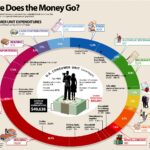
There’s a great infographic posted recently on the Visual Economics Blog.
The infographic design itself is good, because it’s clean, colorful without tooo much information. I think the segmentation of the spending categories is about right, not too coarse but not too fine. I also like the way some of the major categories (food, housing) have been further segmented with sub-detail inside the ring.
Regarding the content and the data, a couple of things struck me. It’s interesting to me to see how much the “average” consumer spends on vices such as tobacco and alcohol, especially considering that large portions of the economy are non users and spend zero on these categories. The fact that people on average spend almost as much on food away from home as they do at home surprised me. Finally, all of us who are homeowners know it, but seeing it graphically reinforces the major component of income devoted to housing and reinforces how it has such a major impact on our current economic situation.
So how do you spend compared to Joe Normal, are you “Average”? What’s the impact of your spending patterns on the economic recovery, and vice versa?
I first came upon the Target ClearRx concept from a post from Matt May’s excellent In Pursuit Of Elegance blog. A sucker for innovative, user based clean design I did a little research on this story. Though it dates back to 2005, it’s a great story of how Necessity Really Is the Mother Of Innovation. Designed by Deborah Adler while still a student at the School Of Visual Arts, this step change reset to the traditional pharmacy pill bottle emerged out of an incident where her Grandmother took her Grandfather’s medicine by mistake sending her to the hospital. Thinking through the problems with the traditional incumbent design, she identified several opportunities:
After rapid prototyping (Remember: Fail Fast Forward), she settled on a solution set which offers a number of clear improvements to the historical pill bottle concept:
Deborah shopped her design, but it was quickly snagged up by Target, who bought the IP and rolled the concept out across their chain. The concept is consistent with Target’s overall brand image and has been an unqualified success. You can learn more about the design and innovation process for ClearRX at Peter Merholz’s Experience Matters blog and in the article “The Perfect Prescription” from New York Magazine.
Personally, I find it to be a great example of how a dominant industry format can be re-engineered from the bottom up by thinking thoughtfully about the way users interact with the product and trying to streamline and improve the user experience via human factors study. Just because a design format is time tested and well entrenched, it doesn’t mean it is immune to innovation.
An article from the LA Times described an ancient bronze and iron computer that predicted astronomical events. Recovered from a shipwreck off a a Greek island bearing it’s name, the Antikythera Mechanism is thought to have been made about 100 BC. It’s important for several reasons, one of which being that it serves as the first verification that the calendar system of months, thought to have been devised by Geminus, was actually used in everyday life at that time, which has long been an ongoing point of historical debate. Even more fascinating to me, is that a dial on the clock predicted the dates and locations of the next several Olympic games. This isn’t so interesting technically, but a pretty strong testament to how strongly the Olympic spirit was woven into the fabric of the ancient Roman culture.
I’m always amazed at “Ancient Technology” and how our ancestors were able to do pretty advanced tasks without electricity, semiconductors, and all the building blocks that we rely on today. This fascinating device demonstrates not only how advanced the level of Mathematical and Astronomical thinking was in Ancient Rome, but also the importance of civil and cultural activities in their lifestyle. Do you have the Olympics or your next government elections in your Blackberry or Google Calendar?
As I tell my kids frequently, “NOTHING is free”. (Apparently Chris Anderson’s new book “FREE” is one exception.) Freemium and Freeconomics are very cool buzzwordy concepts, but at their core, the two concepts of “Free” and “Revenue Model” are mutually exclusive.
I think the real play is the segregation of which constituency is the “User” and which is the “Customer”. The “User” supplies the eyeballs, the traffic, and hopefully the Ad Clickthroughs. In this model, The “Customer” supplies the (Ad Placement) Revenue. In a true for-profit enterprise, there is no Free Lunch from the Customer’s perspective.
If you get something “for FREE”, chances are somebody’s paying. Chances are that somebody may be you, directly or indirectly. Just make sure you’re comfortable with that.
I’m taking the next week off for vacation to drive down to Florida and visit a friend down in my college town of Melbourne Beach. I took the off chance to divert slightly on my route and stop off at Isle of Palms to try to catch a kiteboarding session. There has been absolutely NO wind for 3 weeks in IOP, which is very strange for this time of year, when it normally fires every afternoon like clockwork due to the lowcountry thermal. Coastal Marine Forecast indicated a chance for late afternoon wind, so I took a chance. It wasn’t looking promising on the 2.5 hour drive down from Aiken, but as I made the final approach into Isle of Palms, I saw a number of kites in the air. Oh Yeah!!
Because there has been a wind drought, everyone was there and I saw quite a few of my kitebudddies there. Wind was pretty light, 14 – 16kts, so I went out on a 14meter and a strapless surfboard. Had fun for about 20 minutes, there were waist high waves, which were hittable. I saw a storm coming, but it didn’t look threatening, until I heard the ominous crack of thunder as I was tacking out close to a mile offshore. Nothing will get me heading back to the beach more quickly than thunder, when I have a kite up, not even a fin from Mr Gray.
Waited it out on the beach in the driving rain with my friends for a while, and eventually about half of them gave up and bailed. Zack had 2 SUP’s on his truck, and he was kind enough to let me borrow an epoxy Infinity 11’6″for an hour while we waited for the wind to fill in. He is the standup paddlesurf soul ninja, I am a rank beginner, but had fun nonetheless.
Eventually it cleared up, the sun came out and the wind returned. We put the kites back up and had a great session for an hour or so. The direction shifted, making the lefts totally slappable on the inside, loads of fun. A blazing red sunset dropped beneath the clouds which made for a pretty classic session in the glassed off connections. Total session was about 12.5 miles, include the Stand-up Paddlesurfing, according to my Garmin Connect trace
We hit the beach tired and grinning ear to ear, which was the perfect finish to a tough week in my business.
We pulled anchor early the next AM to head over to Salt Island to dive the wreck of the Rhone. Salt Island is an uninhabited island which historically was used to mine salt from the 2 large salt ponds on the island. The RMS Rhone sunk in 1867, and is one of the few wreck dives where you can see such large portions of the ship’s structure. We were snorkelling only but free dove to 65 – 75 feet and could touch cannons, hatches etc. A great dive. Make sure you hike up the hill by the large salt pond on Salt Island to get the amazing views of the small cove on the north east side of Salt Island.
We then cruised a round Cooper and Ginger Island and over to Fallen Jerusalem. Fallen Jerusalem is a great spot to anchor swim and snorkel, and it doesn’t get near as crowded as the nearby and more famous Baths on Virgin Gorda. I’m not sure what caused it, but there are literally tens of thousands of dead conch shells on the bottom at Fallen Jerusalem, making for an interesting snorkel. We stayed anchored there, but took the tender over to the Baths. This is an interesting hike through many aquatic caves, but I recommend going first thing in the morning, or it is likely to be totally overrun by tourists and very crowded. We then returned to the Moonshadow, and sailed over to Savannah Bay, our anchorage for the evening. After some wakeboarding behind the tender and some cocktails, we were treated to an epic sunset, with great views of Tortola and the Dogs.
After a peaceful night’s sleep in the Norman Island Bight, we pulled anchor relatively early and motored out to the Indians. This popular diving spot has limited mooring balls so we wanted to get out there before the crowd so we could grab a spot.
The Indians is a great dive spot, basically 5 rock outcroppings which rise starkly out of the water. Underneath the surface there are numerous walls, cliffs and tunnels with an amazing variety of sea life based on the positioning in tidal currents. Leah and I took the sea kayak for a paddle around Pelican Island.
We then sailed to Deadman’s Bay on Peter Island for the afternoon. We had a nice lunch on the boat and then went to the beach to chill.
The breeze was filling in , even though Deadman’s Bay is somewhat shielded from the prevailing trades by the rock cliffs on the east end. I could see whitecaps out in the channel, and I was itching to see if I could could get the kite up, so I went to the beach to rig. I was able to launch but the wind was too light / variable to do much riding. The wind was effectively blowing straight offshore once I got out the bay, and I was a little bit worried about drifting across to Tortola if I dropped the kite, so I bagged it.
We did some tubing in the bay behind the tender, which my daughters loved. Then we motored over to Grand Harbor, had sunset cocktails and dinner, and settled down for the evening.