20 Miles Kiteboarding At Wayside Park

December 28th, 2009 · 7:01 pm  →  Fun

Had a cold but fun good session in the sound at Wayside park today, wind was highly variable, up and down between 12 and 19 knots from the NNW.   I would alternate between being fighting to stay on plane to being nicely powered.    I was on a Rebel 14 meter kite and split the time between a twin tip and a strapless surfboard.   It was cooooold, 45 – 50 F, I had to take a break in the middle to get some warmth back in my fingertips.  My Garmin Connect tracks are here.

Share

16 Miles Kiteboarding In The Gulf On Christmas Eve Eve

December 24th, 2009 · 4:07 pm  →  Fun

Had a good session in the Gulf yesterday, wind was 14 – 22 knots ESE, with overhead wind swell on the outside.  I was on a Rebel 14 meter kite and split the time between a twin tip and a strapless surfboard.   Forecast for today (Christmas Eve) called for 30 knots, but it hasn’t showed up yet, and it’s been raining all day.  Maybe Santa will deliver again on Christmas day!!

Share

The World According to Americans

December 13th, 2009 · 10:23 am  →  Culture

Although hopefully an overstated generalization, this cartoon map sums up many of the flawed and uneducated perspectives of (at least some) Americans.   Put together, they do not create a very attractive picture of our country of our people, do they?   If you are American, please do your part, especially when dealing with those from other cultures, not to act like a jackass.   It reflects poorly on the rest of us.

Posted via web from jeffreyjdavis’s posterous

Share

Don’t Be Afraid To Stand Out From Your Crowd

December 9th, 2009 · 2:50 pm  →  Leadership

I’ve had this picture on my hard drive for a while; I don’t even remember where I got it.  Every time I see the thumbnail, I can’t help but smile, or even laugh.  Best I can tell, it’s a legit, non-photoshopped family picture, probably snapped begrudgingly in the portrait studio at a Wal*Mart somewhere in southern Indiana.  I can imagine that there is some pretty interesting drama in that family.

But you have to respect the second son.  He knows who he is, and he knows who he is not.  Despite the conformal pressure in his family unit, he’s his own man, and probably always will be.  I’m sure he will be an effective leader one day, and I respect his individuality.

Be true to yourself, regardless of who the system tells you you should be. Excel based on your achievements, not based on your appearance.  If the system tries to program you for sweater vest and clip on bow-tie but your inner Axl Rose promises organ rejection, you know which way to go . . .

Posted via email from jeffreyjdavis’s posterous

Share

Risk, Part 1 — Stress Testing Your Business Strategy
December 5th, 2009 · 1:03 pm  →  Business
WalnutShellIN A NUTSHELL:  Part 1 of 3 — The economic environment has dramatically reshaped the external environment of many companies, including yours. Use this framework to stress test your current business strategies so that you are well-positioned for the new realities.

Part 2 of this series can be found here.

Part 3 of this series can be found here.

We all know that the world has changed dramatically over the last 24 months.  Things are happening in the external business environment which have never happened before, and words like “unprecedented”, “meltdown” and “crisis” have become the  fodder of normal everyday conversations.  In this type of environment, which is still rapidly evolving, it is wise not to take anything for granted.  Not even the things which you’ve always taken for granted.  Especially not the things which you’ve always taken for granted.  In the next 3 part series of posts, I’d like to walk briefly through some thought processes for thinking about risk in your company and developing plans to deal with those risks.  Intelligently dealing with risk really involves four key thought processes:

  1. Contemplating the range of scenarios which COULD happen,
  2. Actively considering, as best possible, the likelihood that each of those WOULD happen,
  3. Developing strategies to detect as early as possible that one of those scenarios IS happening,  and
  4. Having a mitigation or response plan which can be quickly executed in the case the scenario DOES happen.

In this first post I will start at a high level, that of risks to your business strategies.  In the next post, I will discuss how to think about risks to your daily business operations.  In the third and last post, I will discuss risks to your organization and your teams.

Every company hopefully has a set of strategies which it formulates and executes to help it meet its objectives.  (For the purposes of this post I am going to assume that your company already has a set of clearly articulated strategies which you have already agreed on.)  A good set of strategies is formulated based on your company’s posititioning relative to its external environment (customers, suppliers, competitors, regulatory, etc.)

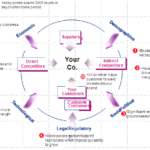
In the same way that Michael Porter’s Five Forces Model is a useful framework for developing your company strategies, it can also be a good tool for “stress testing” your strategies.    Pull out the output documents from your company’s last strategic planning session and briefly review as a team the course you charted at that time.  After reviewing your strategies, go around each of the five segments of Porter’s model and brainstorm several of the most extreme and surprising changes which you could imagine happening to your company’s environment.  I advise you to really step back and detach your self from the situation;  it may help you to think more broadly if you imagine what could happen to a competitor, as opposed to yourself.  (For whatever reason, people never seem to be pragmatic or realistic enough about the  possibility of bad things actually happening to themselves, but find it easy to imagine them happening to someone else.)  The range of scenarios you come up with should be extreme and include such things as key customers going bankrupt, drastic inflation in key raw materials,  significant overhauls in regulatory constraints, or an indirect competitor totally obsoleting your business model.  I would advise shooting for two to four scenarios for each element of the external environment, so that you end up with a list of between 10 and 15 scenarios which could potentially play out.

Porter's Five Forces

Porter's Five Forces

Now think about each of these environmental changes from two different dimensions:  (1) How likely is it actually to happen?, and (2) What would the impact be on our company and our current strategies?  Arrange your situational possibilities on a two axis grid with the x-axis representing the perceived likelihood and the y-axis representing the potential impact to your company and its current strategies.  Try to force some segregation, so that everything isn’t automatically highly likely and high impact.  You should end up with a grid looking something like the figure below:

Environmental Factors

Environmental Factors

Divide the cluster roughly in half, and think carefully about the how would you cope with the possibilities in the right upper quadrant of the plot:

  • Would our current strategies still be effective in the event that the scenario played out?
  • If not, how could we modify our strategies to make them more capable in the new environment?
  • How would we know if one of those scenarios were actually beginning to develop?
  • Would any of these situations offer up any new opportunities for competitive advantage for our company?

I recommend assigning  key members of your senior leadership team the responsibility of continuously monitoring one each  of these potentially high impact trends so that you can mobilize your strategic shifts as early as possible in the event of occurence.  Using this kind of review periodically (at a minimum annually) will help you to keep your company’s strategies tuned to your rapidly evolving environment and will make sure your company remains positioned to respond to emerging threats and to capitalize on new opportunities in your external environment.  How has your company adopted its strategic planning and review process in response to the current economic environment?

Check back soon for Part 2 of this series,  Operational Execution.

Share

Falling Artist Suspended In Time

December 3rd, 2009 · 4:28 pm  →  Art

Kerry Skarbakka photographs himself falling from trees, jumping off bridges and in the midst of fires – all in the name of art. Inspired by the helplessness he felt after the 9/11 attacks, Kerry’s work captures him frozen in a moment of peril. This collection of 13 shots is compelling in it’s combination of performance art and “in the moment” photography. I seriously hope he didn’t have multiple takes for some of these shots.

Posted via web from jeffreyjdavis’s posterous

Share