Very Small People In A Very Big World

October 31st, 2009 · 9:59 am  →  Art

This amazing collection of micro-montages creates tiny human drama in the un-noticed corners of our very large scale urban life. Please visit Do-While to enjoy this very creative collection.

Posted via web from jeffreyjdavis’s posterous

Share

Private Equity 2.0

October 29th, 2009 · 2:53 pm  →  Business
WalnutShellIN A NUTSHELL: The financial crisis has had important implications for Private Equity sponsors, and the funds that will be successful in the future may need to adapt their strategies to earn consistent returns.

Disclaimer:  I am an executive in a private equity sponsored company, we have a very supportive sponsor, and I truly believe in the potential of the private equity model to boost the economy, without tax-payer stimulus dollars.

Image: CCL - Brave New Films

Image: CCL - Brave New Films

People tend to be strongly polarized regarding the role of private equity and it’s potential for benefit or harm.  Proponents cite the fact that the focus on EBITDA and free cash generation which PE groups drive is actually beneficial for many company management teams.  It’s hard to argue with the fact that with some skin in the game, operating management teams typically have incentive structures which drive them to relentlessly focus on their companies’ performance.  And there are many stories of firms where a strong and involved private equity backer helped a management team eliminate huge amounts of waste and unlock large amounts of shareholder value.  But for every positive story, there are a number of negative value erosion exploits which can be told.  Many deals were done as mere financial engineering demonstrations with little to no actual improvement in  business fundamentals.  The market’s addiction to leverage unfortunately frothed to a point where many respectable, longstanding franchises were driven into re-organization or receivership due to debt service loads which were incapable of being managed through even the slightest of downturns.   At the deal market’s peak, a churn mentality was prevalent with hold times of less than 2 years, which clearly drove a short term focus on results and a lack of re- investment in the firms’ future capabilities.

As the global economy begins to think about trying to crawl out of the last 24 months’ meltdown, the Private Equity world reaches an  interesting branch in the road.  More than $500B of portfolio company debt will mature over the next 4- 5 years, and it is unclear whether there will be sufficient risk-tolerant liquidity to fund many of the recapitalizations.  A number of newer or less prudent funds have tumors in their portfolios, some diagnosed, but many probably not as of yet.    Experts have estimated that as many as 1 in 4 of current funds will fail or will need to be severely restructured.   Although we frequently hear of the huge stashes of dry powder on the sidelines, without properly structured debt financing, this money is unlikely to get deployed any time soon.    More than 20% of current vintage funds are more than three-fourths committed on their current capital raise, meaning that they will have to wait for institutional investors to regain their appetite for alternative investments before they can receive additional investment fuel.

So, will Private Equity go away?  Unlikely.  It has been an engine for recovery for the last several economic cycles, and it is unlikely that this one will be any different.  What will be different, I believe, is the kind of Private Equity firms who will emerge as winners in the landscape of Private Equity 2.0.  My fairly obvious  predictions:

  • There will be fewer deals and it will be quite some time before the deal market regains any level of irrational exuberance.  Fewer deals means more time to do deals right.  Firms will be more selective and firms that have very solid due diligence and value recognition processes will capture more of the upside than those which are impatient or inperceptive.  Fewer deals also means more time to negotiate tough, and more firms will realize that money is made more from the buy and less from the sell.
  • Deals will be less levered, so by definition, returns will be lower.  It will not be uncommon to see deals with more equity than debt or even all equity deals.  Firms will either need to raise larger funds to reduce fund concentration or will need to have the courage to make relatively large concentrated equity investments.
  • Hold horizons will be longer.  Deals that are held in a portfolio for 5 to 10 years will not be uncommon.  Private equity groups will need to have the vision, patience and the constancy of leadership to fund and enact long term multi-year improvement strategies in their portfolio companies.  Not all PE groups have this headset today.  LP capital return expectations and timelines may need to be extended accordingly.
  • The firms that will win will be the groups that can bring real value creation expertise to the table.  The days of just betting on a solid management team, incentivizing them and amplifying their progress with a heavy dose of leverage and letting the portfolio company print equity returns on it’s own have probably passed.  Although many PEG’s have solid operating partner teams today, the groups that will win will probably be the ones that develop full in house multi-functional consultancy capability (LEAN, six sigma, strategy, value selling, global expansion, change management) which can be deployed to address opportunities in the portfolio.  Additionally, the tougher environment will probably drive a premium on developing true domain expertise via multiple sequential investments in a sector.  This trend will allow savvy PE groups to identify value plays which may not be obvious and will also enable inter-portfolio synergies which will be accretive for both companies.
  • As returns get squeezed, the often overlooked EBITDA drain of service providers on the portfolio companies may become a focal point and an opportunity for well capitalized private equity groups.  We may see sponsor groups which totally centralize and/or insource service providers, including public accountants, retained executive search, legal firms, risk assessment firms, environmental management firms, IT and other back office tasks.  While this would start to blur the line between financial sponsor and conglomerate, it probably could account for 2 – 3% of EBITDA margin lift across the portfolio.
  • Finally, I think the firms which win will be the groups that invest most heavily in the talent management of their portfolio companies.  Private equity groups will begin to have fully resourced human capital teams and will be heavily involved in recruiting into the portfolio company, and not just at the C-suite.  New manager assimilations, 360 appraisals and detailed organizational leadership development plans will become the norm and will be driven by the equity sponsor if they are not already a part of the portfolio company’s DNA.  Incentive structures for management will continue to be highly tied to company performance, but will probably take on a greater degree of long term value creation.  Top-talent retention will become even more paramount than it is today.  PE groups’  HR processes will begin to look much more like those of blue-chip Fortune 500 companies than they have historically.

Just like in nature, a changing environment requires adaptation for survival.  It is difficult to predict exactly how the Private Equity industry will adapt as it comes out of this downturn, but I think it is safe to say that the industry will adapt in many ways.  Only time will tell.  What do you predict?

Share

Schwarzenegger Gives California Legislature The (Subtle) Finger

October 28th, 2009 · 7:10 am  →  Government

On a par with 4Chan’s  “Marble Cake, Also The Game”, you have to really appreciate the thought and planning that went into the Governator’s tersely worded rejection of Bill 1176. He, (or some devious member of his admin staff) apparently has a mastery of vocabulary and font kerning that goes beyond that of mere mortals.

Apparently in the leadup, Assemblyman Tom Ammiano told Schwarzenegger to “Kiss His Gay Ass!”.  I guess this is what message Mr Ammiano received back.  I think Arnold wins that battle, at least on a degree of difficulty and style point basis.

I’m big on transparency (and embedded subliminal messaging) in Government. I’m Lovin’ It!!

Posted via web from jeffreyjdavis’s posterous

Share

Left vs Right : Two Sides Of The Idealogic Coin, From Every Angle

October 21st, 2009 · 9:21 am  →  Blog Culture

This interesting infographic compares Left-leaning views with Right-leaning views from almost every dimension. Obviously, some simplifications, generalizations and stereotypes must be made to do such a comparison, but on the whole, most of the assessments are pretty valid, and it does not appear that there was any overarching bias one way or the other.   An interesting look, if I do say so myself.

Posted via web from jeffreyjdavis’s posterous

Share

Staggering Photographic Evidence Of Man’s Impact On The Ecosystem

October 18th, 2009 · 1:45 pm  →  Science / Nature

This gut-wrenching collection of photos from the Midway Atoll documents dead albatross chicks who have been fed plastic trash by their parents. Every day, their parents fly out over the polluted Pacific and bring back colorful plastic, which they think is food. Every year, tens of thousands of albatross die this way on tiny Midway Atoll. Midway is over 2000 miles away from the nearest continent. None of these photos have been manipulated in any way. Protect the ocean, don’t throw trash overboard, don’t let your trash blow into the ocean. Join the Surfrider Foundation if you are not already a member.

Posted via web from jeffreyjdavis’s posterous

Share

Throw Away Conventional Economics: YouTube’s Bandwidth Bill Is Zero.
October 17th, 2009 · 7:47 am  →  Blog Technology

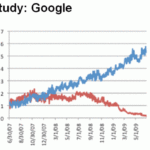
casestudygoogle

This interesting article from WIRED puts practical context around the arguments made in Chris Anderson’s thought provoking book “Free” and explains how Google is leveraging global server farm consolidation and intelligent purchase and subsequent barter of Dark Fiber to make YouTube’s bandwidth bill negligible. The macroeconomics you learned in college no longer apply.

Posted via web from jeffreyjdavis’s posterous

Share

Get Granular To Get More Done During Your Day
October 16th, 2009 · 10:00 am  →  Blog Personal Productivity
WalnutShellIN A NUTSHELL: A simply daily planning and review habit can dramatically increase your productivity and execution, for an investment of only 18 minutes per day.

Allow  me let you in on a couple of things about myself:

I am very task, detail, and plan oriented when I manage or review large projects at work.  I insist on seeing detailed execution plans and Gantt Charts and am always asking “How long is it going to take?”, “When are you going to start?”, and “When will you be finished?”.  Detail oriented to a fault.

I am also pretty diligent about my own personal planning systems and have been a pretty devoted Getting Things Done practitioner for the last 3 – 4 years.    I have a pretty robust trusted system in Lotus Notes based around Eric Mack’s great eProductivity software which tracks all my work and personal projects and all of the next actions required to get those projects completed.

But somehow I never really connected those two sides of my psyche to apply my detailed project planning bent to the ways I actually schedule my work on a daily basis.  I just never really made the link to the need for personal planning discipline and rigor at a granular level somehow, and I frequently felt like I didn’t get as much done in a 12 hour day as I should have / could have.  I had a bit of a revelation when I read Peter Bregman’s “An 18-Minute Plan For Managing Your Day”, which speaks about a simple, obvious ritual for planning your day’s time and reviewing your day’s accomplishments.  (Basically spend a total of 18 minutes planning and tracking your day: 5 minutes at the outset to plan the day, 1 minute at the top of every hour to review progress and recalibrate, and 5 minutes at the end of the day to review the day.)   I tried it for several days, and it’s so  simple that it actually worked.  So then I tweaked the process a little bit, introducing some low-tech mind-tricks to help ensure that I would be able to make the habits stick.

My basic daily planning ritual is outlined below:

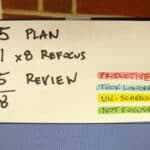
  • Jedi Mind Hack #1: I designed and built a sophisticated reminder system which I then integrated into my computer display monitor.  (A 3×5 index card with a basic reminder about the 18 minute commitment, scotch tape hinged to the top of my monitor.)  Every night when I leave the office, I flip this down so that it’s the first thing I see when I power up in the morning.  Whenever I leave for a meeting, I flip it down as I’m turning off the lights in my office, so that I’m reminded when I return.
5 + 8x1 + 5 = 18 minutes

5 + 8x1 + 5 = 18 minutes

  • Each night before I leave the office, I print out the “Daily View” of my calendar, so that it’s there for me when I arrive the next day, and I can work on my daily plan while my computer is booting up.
  • When I arrive in the morning, I spend the first 5 minutes or so planning out the day based on how much white space I have in between meetings.  This is the key part that I never really grasped before.  You have to plan something and schedule it if you really want to maximize your chance of actually doing it.  How much time is available in my day in contiguous free time blocks?  What are the key next actions  on my “Do Today” list?  (The Today flag is a great GTD tweak implemented in eProductivity, by the way.)  Which can I really knock out today?  How long should each task take if I really focus?  When do I want to start and finish?  I draw a line dividing my daily calendar printout into a left and right side, and pencil in my Plan for the day on the left, fitting my tasks into the available time windows.  A key point is being as realistic as possible about how long things will actually take.  Time is a finite constrained resource;  Set yourself up to be successful and don’t unrealistically over-commit your day.
Plan on the Left, Actual On The Right

Plan on the Left, Actual On The Right

  • I carry this printout around with me all day in my journal.
  • Every hour, I glance at it for a minute or two and document on the right half of the page what I Actually worked on during the last 60 minutes.    I know a lot of people have espoused the benefits of time journals, but it is a useful technique for helping you understand where your time goes.  My print format breaks each hour into 15 minute blocks and I track my time granularly down to these quarter hour increments.  It’s pretty important to do this frequently throughout the day if you want to have a hope of remembering what actually happened when.  I find that the 2 – 3 minutes while a meeting is waiting to get started is a good time to do your hourly 1 minute relook.  Capture anything over about 15 minutes:  Capture the 15 minute unplanned discussion in the hallway, or the 30 minute call you ended up having to make or the fact that the meeting scheduled for 60 minutes actually went 75 minutes.  You planned on having that time, and you lost it as a free time block.  This isn’t necessarily a bad thing but it does cause you to adjust your plan for the day.
  • Jedi Mind Hack #2: Highligters.  They’re fun.  They’re colorful.  Colorful and fun things help reinforce behaviors if you still have a persistent inner child.  I categorize my actual time usage under four very rough categories along the right margin of my daily schedule print:
  • Pink: Productive Time, Great Work, Getting Things Done.
  • Blue: Productive Time, but a Schedule overrun, tasks or meetings that took longer than scheduled or budgeted.
  • Yellow: Un-Scheduled Drop-Ins.  These are the miscellaneous crises and last minute meetings and discussions which can eat a tremendous part of your day’s white space sometimes.
  • Green:  Un-Focused Time.  This is that black hole of mystery time, that just evaporates, unfortunately without leaving much of a trail of productive accomplishment  in it’s wake.  You may be distracted playing on the web, or you may just be trying to work on something productively but for some reason spinning your wheels.  Take a walk, clear your head, and try again.  Tracking this available capacity leakage is a key part of getting more done.
  • At the end of the day, spend five minutes reviewing your actual time spent versus your planning budget from 12 hours ago.  Think about what could have caused you to go green and lose productive time, or about how you could have minimized some of the unscheduled interruptions. Consider why you may be one who insists on packing 10 pounds  of work into a 5 pound bag.  Save your printouts and see if you find persistent daily patterns (i.e. Great Work early in the morning, Loss of focus after lunch, etc.)  Adopt your daily planning accordingly.

Everyone’s different.  You may not need this level of rigor in your daily execution.  You may be disciplined enough to get stuff done without well-grooved habits and mind tricks.  But for me, this approach helped a lot, kept me focused and allowed me to dynamically reallocate my schedule during the day based on changing priorities or unplanned but urgent activities.  As always, your mileage may vary, but please let me know in the comments your experience  if you try or use some variant of this approach.

Share

You ARE Musically Talented, By Way Of The Virtual Piano

October 12th, 2009 · 8:10 pm  →  Blog Fun

I personally challenge you not to waste hours amazing yourself with your innate musical ability on this cool quasi-educational music tool. Press any three piano keys, then one of the chords (the numbers) below the keys. Lather, Rinse, Repeat. You will be moved to tears.

Posted via web from jeffreyjdavis’s posterous

Share

A Global View Of The Housing Bubble

October 8th, 2009 · 12:43 pm  →  Blog Business

This interesting graph from McKinsey highlights the tremendous run up in home prices on inflation adjusted terms over the last 40 years since 1970. This runup reversed abruptly last year, with the US shedding 10% of value and the remainder of the global economies losing in aggregate around 4%. This slide equates to nearly $3.5 trillion dollars of personal wealth evaporation. Considering the immense mortgage leverage overhang on many of these homes and the chance that any appreciation will be slow to come, this global housing bubble will certainly dampen growth in consumption and global economic recovery.

Posted via web from jeffreyjdavis’s posterous

Share

AGY Shanghai Customer Open Day

October 5th, 2009 · 2:11 pm  →  Blog Composites
WalnutShellIN A NUTSHELL: AGY held a Global Customer Open Day for its AGY Shanghai Technology Company on 09/01/09.

On September 1, 2009, I turned 47 years old.  Not a  particularly relevant milestone, other than I have realized that statistically I am probably past the midpoint of my stay on this planet.  So I guess I  better get busy and accomplish all the life goals still on my list.  On September 1, 2009, AGY also held a Customer Open Day for our new facility, AGY Shanghai Technology, Co. Ltd.  This event was memorable for me on several fronts.

I began working on AGY’s acquisition of Grace’s  Shanghai Grace Technologies business in December of 2007.  While both parties were very willing and the deal made great since for both companies, as is normal, there is always the normal “Valuation Gap” between the Buyer’s perspective and the Seller’s perspective.  What started out as a normal gap, became a chasm over the following 18 months as the global economic downturn took it’s toll on the performance of the target and the liquidity of the purchaser.  This deal evolved and morphed into several totally different structures throughout the process, which included more than a couple of “walk away” events.  The process also involved many many trips to China and Taiwan for myself  as well as the privilege of sleeping 152 nights in 2008 in the Pudong Courtyard Marriott.  Needless to say, when we finally closed the transaction on June 10, 2009, I felt great accomplishment and relief.

While the facility we purchased was already world class in terms of assets and organization, we are working hard to transfer AGY technology for fine and ultra-fine yarns to the production processes in Shanghai.  To this end, we have had a team of people embedded in  Shanghai since early 2009 working on the technology upgrade.  Because the business we bought is co-located on a campus with Shanghai Grace Fabrics (an existing large AGY customer), we have also been working hard  on cutting all the organizational cords between the Fabrics business (our customer and the competitor of most of our other customers)  and the Yarns business (which we purchased).  AGY prides itself on being the leading global independent yarn maker in a largely  integrated industry, and making it crystal clear to all of our customers that we are 100% separate from the Grace Fabrics business has been a critical initiative.

On September 1, before the China Composites Show, we personally  invited the press and a number of global current and potential customers to tour our facility.  We hosted customers from China, Taiwan, Japan, US and Europe.  We wanted to give them  a chance to see first hand the technology, operational discipline, and quality mindset present in our world class AGY Shanghai operations.    I gave a brief presentation, then we took a tour of the operations, and then we treated them to dinner aboard a HuangPu River cruise (and the weather cooperated with beautiful views and comfortable weather).  All customers had a great time, and we generated significant interest in purchasing from the facility.

I cannot begin to tell you the pride I felt throughout this entire event.  Seeing the assets branded with AGY’s corporate identity, seeing the enthusiasm and engagement from our newest AGY employees, and seeing the favorable impressions of our global customers really filled me with pride and accomplishment.  Something that took so long to negotiate and which several times seemed like it would never be completed, had finally been consummated.  I could see the tangible output of my perseverance and involvement, which left me with a great deal of satisfaction.

Thanks to all AGY customers for your business and for making our Customer Open Day a success!!

AGY Shanghai Technology Co.

AGY Shanghai Technology Co.

Jeffrey J Davis Giving A Customer Welcome Presentation

Jeffrey J Davis Giving A Customer Welcome Presentation

Customers in the AGY Shanghai Auditorium

Customers in the AGY Shanghai Auditorium

Kawai-san and Rober Tsai from Asahi Schweibel Taiwan In Our Glass Analysis Lab

Kawai-san and Rober Tsai from Asahi Schweibel Taiwan In Our Glass Analysis Lab

Customers Touring Our Forming Tunnel

Customers Touring Our Forming Tunnel

Customers in Our Fabrication (Twist Frame) Area

Customers in Our Fabrication (Twist Frame) Area

I almost cried when I saw these flags blowing on the wind on the dinner cruise.

I almost cried when I saw these flags blowing on the wind on the dinner cruise.

Traditional ErHu and Pipa music to accompany dinner on the boat

Traditional ErHu and Pipa music to accompany dinner on the boat

Orient Pearl as viewed from the boat

Orient Pearl as viewed from the boat

AGY CustomerS: Thank You For Your Business!!

AGY CustomerS: Thank You For Your Business!!

Share